Notebook Editable File KDP Paperback Graphics Review
As a graphic designer, I live and die by the details of my assets. When a client comes to me with a request for a print-on-demand product—specifically a KDP paperback notebook—I don’t just look at the cover art. I look at the interior structure, the file integrity, and how easily the design can be adapted to different brand voices. Recently, I was tasked with creating a cohesive stationery line for a boutique lifestyle brand that sells on Etsy and Amazon. The brief required a clean, professional interior that felt handmade but executed with corporate precision. That is when I evaluated the Notebook Editable File KDP Paperback.
This review isn’t about whether the file looks pretty; it’s about whether it works in a real-world commercial workflow. After testing this asset across various mockups, print proofs, and digital layouts, here is my honest assessment of its utility for designers, brand owners, and content creators.
First Impressions: The Mood and Visual Language
The moment I opened the source files, the visual language was clear. This is not a chaotic, maximalist design asset. It leans heavily into modern design principles with a focus on clarity and usability. The aesthetic feels grounded, suitable for a wide range of industries from corporate training journals to creative brainstorming pads. It creates a mood of organized creativity, which is exactly what most clients want when they are launching a new line of notebooks.
The style represents a bridge between traditional editorial design and contemporary digital minimalism. It fits naturally into projects that require trust and professionalism without feeling sterile. For a small business branding project, this asset provides a reliable foundation. It doesn’t scream for attention; instead, it supports the brand identity by providing a clean canvas that allows your logo, color palette, and typography to take center stage. If you are building a brand identity around productivity, education, or mindfulness, this design bundle offers the right emotional appeal.
Performance in Real Design Situations
I tested this editable file across several different design scenarios to see how it held up. Here is where it performed best:
- Packaging Design and Product Mockups: When placed on a 3D mockup of a spiral-bound or perfect-bound book, the layout maintained its structural integrity. The margins were generous enough to prevent text from getting lost in the binding, which is a common pain point in KDP projects.
- Social Media Graphics and Pinterest Pins: For marketing visuals, this asset is incredibly versatile. I used it as a background element for Instagram posts promoting a digital planner. The clean lines allowed me to overlay bold sans serif font headers without cluttering the composition. It worked seamlessly as a supporting brand element in a campaign visual.
- Sticker Design and Sublimation Design: While primarily an interior page file, the geometric elements within the design can be extracted for sticker design or sublimation design projects. I found that the vector-based components scaled beautifully for vinyl decals, adding a touch of professionalism to handmade business products.
- T-shirt Design and Merchandise: Although niche, the minimalist aesthetic translates well to apparel graphics when used as a subtle texture or background layer. It adds depth to t-shirt design without overwhelming the primary illustration.
However, the asset is less effective in crowded layouts or complex backgrounds. Because the design relies on negative space to breathe, placing it behind busy photographic textures can diminish its impact. It is also not ideal for very small sizes, such as favicon usage or tiny social media icons, where the detail might get lost.
Technical Workflow and File Compatibility
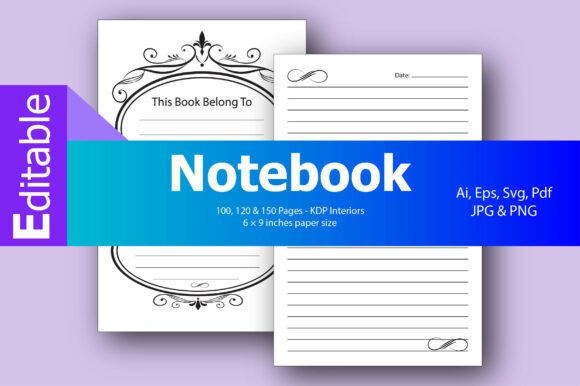
One of the strongest selling points of this graphic design asset is its editability. The product description mentions that you can Download “ Notebook Editable File 6×9 inches paper ” instantly with PDF ready to upload on KDP with Illustrator, InDesign source files for customization. This is crucial for professional workflows.
Having access to the source files means I wasn’t stuck with a static image. I could tweak the grid, adjust the spacing, and align the elements to match the client’s specific brand guidelines. The specification notes dimensions of 8.5″ x 11″ Inches, which is standard for many educational and business notebooks, making it easy to integrate into existing templates.
For those using Canva template workflows or working directly in Adobe Creative Cloud, the flexibility is a game-changer. You aren’t just buying a PNG design; you are acquiring a tool that speeds up production. This is particularly valuable for digital sellers who need to create variations of a single product quickly. Whether you are designing for a Cricut project or preparing a high-volume print-on-demand run, having editable layers saves hours of manual work.
Designer Notes: What to Check Before Commercial Use
Before slapping a client logo on this asset and sending it to print, there are several technical checks any experienced designer should perform. Ignoring these steps can lead to costly reprints or poor user experiences.
- Test in Black and White: Print the page out in grayscale. Does the hierarchy still hold up? Sometimes colors mask poor contrast issues. Ensure that the lines and text blocks remain distinct without color cues.
- Check Contrast on Light and Dark Backgrounds: If you plan to use this as a digital download or a web graphic, test it against both white and dark mode backgrounds. Ensure that any transparent elements (if included as a PNG design) blend correctly.
- Preview at Small and Large Sizes: Zoom out to 25% and zoom in to 400%. At thumbnail size, does the design still read clearly? On large format posters or billboards, do the lines appear too thin or pixelated?
- Inspect SVG or Vector Editability: Verify that all elements are indeed vectors. Rasterized text or images within a vector file will lose quality when resized. Open the file in Illustrator and check each layer.
- Compare Font Styles: Look closely at the typography used in the sample. Is it a serif font, sans serif font, script font, handwritten font, or display font? Ensure it complements your chosen brand typeface. If the default font clashes with your client’s logo, you will need to replace it entirely.
- Confirm Commercial Licensing: This is non-negotiable. Before using this for a client or business project, read the license agreement carefully. Does it allow for end-product resale? Some design assets are for personal use only. For commercial design, you need explicit permission to sell items created with the asset.
Final Verdict on Readability and Brand Trust
The ultimate goal of any design project is to build trust. When a customer opens a notebook, the first thing they notice is the interior. A messy, misaligned, or low-resolution interior undermines the perceived value of the product, no matter how beautiful the cover is. The Notebook Editable File KDP Paperback excels in maintaining visual hierarchy and readability. It guides the eye naturally across the page, ensuring that the user experience is smooth and professional.
For editors, bloggers, and publishers, this asset reduces the cognitive load on the reader. It feels familiar and comfortable, which increases engagement. For marketers, it provides a polished backdrop that elevates the overall impression of the brand. It signals that you pay attention to detail, which is a key factor in conversion rates for online stores.
In conclusion, this is a solid, practical addition to any designer’s library of design assets. It is not a flashy, trend-driven piece that will look outdated in six months. Instead, it is a timeless, functional tool that supports a wide variety of creative design needs. Whether you are a seasoned pro looking to speed up your KDP workflow or a crafter starting your first Etsy product launch, this file offers the flexibility and quality needed to succeed. Just remember to always proofread, check your bleed settings, and respect the licensing terms. When used correctly, it helps transform a simple notebook into a premium brand experience.